
Editorial introduction
Volume 1, Issue 1 established water as an active process material and announced that the next issue would develop applied water treatment and quality control. This issue keeps that commitment and follows water through the complete laundry utility system: source, storage, treatment, process use, drainage, reuse, boiler feedwater, steam generation, condensate return, monitoring and corrective action.
A laundry can optimise an individual machine and still waste water or energy if the surrounding utility system is poorly matched. The professional objective is therefore to understand the interfaces between water quality, process demand, steam, drainage, recovery and control. Each section in this issue should be adapted to the actual site, textile classification, chemistry, hygiene duty, equipment and applicable regulation.
How to use this issue
The six system banners provide a visual summary. The accompanying text explains what should be verified before a concept becomes a design or operating practice. The diagrams are not construction drawings and are not to scale. Final specifications require site measurements, water analysis, risk assessment, equipment data and competent engineering review.
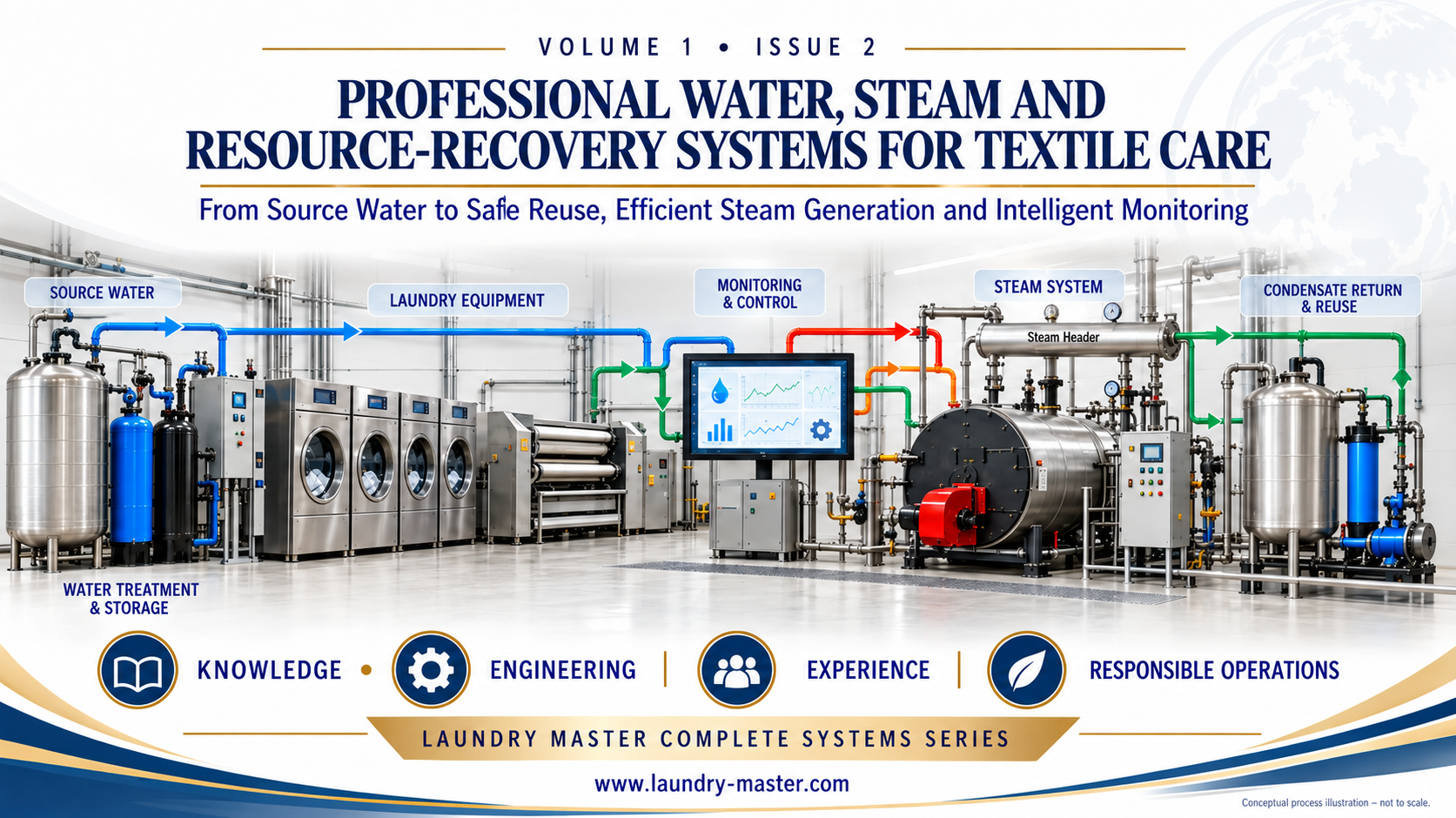
Complete system overview
The complete system links source water, laundry equipment, steam, condensate return, reuse and monitoring.
The useful boundary of a laundry system begins before water reaches the washer and ends after the last recoverable heat and water stream has been evaluated. Source-water variation affects treatment. Treatment affects wash chemistry and boiler performance. Machine selection determines water, steam, drainage and airflow demand. Condensate return changes boiler make-up and heat demand. Water reuse changes the chemistry presented to an earlier wash stage.
These relationships mean that a change in one part of the plant can move cost or risk elsewhere. Lowering water volume without checking rinsing may leave residual chemistry. Returning condensate without monitoring can carry contamination into the boiler house. Reusing rinse water without separated drains can convert a useful stream into mixed wastewater. The correct design question is therefore whether the complete system remains safe, controllable and economically justified.
Design information required
- Daily and peak production by textile classification
- Water sources, analysis, seasonal variation and supply reliability
- Actual machine programmes, fill volumes, flow rates and drainage sequences
- Steam pressures, loads, trap condition and condensate return arrangements
- Wastewater quality, discharge costs and local permit conditions
- Hygiene, cross-contamination and clean-side requirements
- Metering points, alarms, maintenance capacity and operator competence
1 Water sources and storage
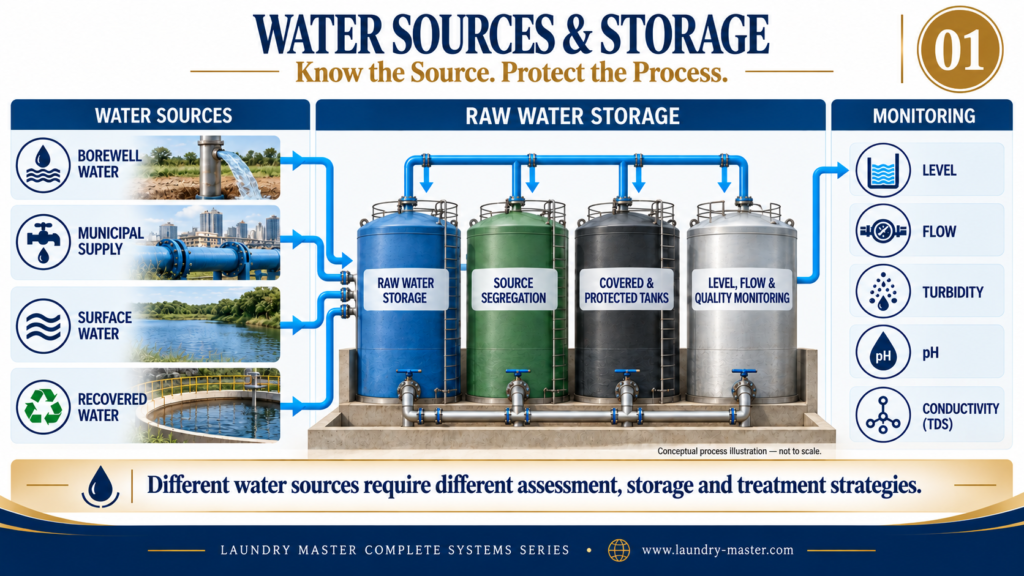
Know the source before choosing treatment
Municipal water, borewell water, surface water and recovered water do not present the same risks. A municipal supply may vary with network operation and disinfection practice. Groundwater may carry hardness, iron, manganese or salinity. Surface water can change rapidly with weather and suspended solids. Recovered water carries residues from its previous use and requires a specification for its next use.
A single sample provides only a snapshot. New projects should obtain representative analysis, and operating plants should trend the parameters that influence their process. Sampling locations should distinguish incoming water, treated water, storage, distribution and point of use. Where two sources are blended, the blend ratio and its variation also matter.
Storage is part of treatment control
A treated-water tank can undo good treatment if it permits sediment accumulation, biological growth, contamination through an open vent or long stagnation. Tanks should be covered, accessible for inspection and cleaning, protected from cross-connections and arranged to avoid uncontrolled dead zones. Level, turnover, overflow, drainage and pump control should be considered together.
| Source or location | Typical questions | Useful checks |
|---|---|---|
| Municipal supply | Is quality stable through the day and season? | Pressure, residual disinfectant where relevant, hardness, conductivity and turbidity trends |
| Borewell | Are minerals, salinity or suspended solids changing? | Full analysis, pump condition, bore integrity and seasonal comparison |
| Surface water | How do rainfall and upstream activity affect quality? | Turbidity, colour, microbiological risk and treatment loading |
| Recovered water | What was its previous use and intended next use? | Stage-specific chemistry, colour, solids, hygiene and fail-safe diversion |
| Storage tank | Can stored water be recontaminated or stagnate? | Cover, vent, turnover, sediment, cleaning record, level and overflow |
2 Water treatment and distribution
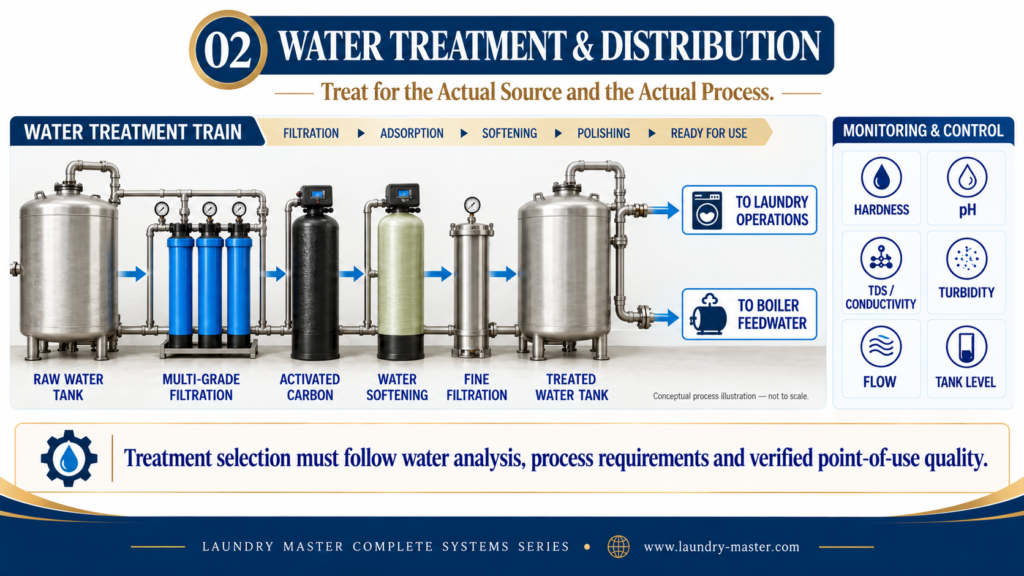
Treatment must match a defined problem
Filtration, activated carbon, softening, fine filtration, membrane treatment and disinfection perform different functions. A filter that removes suspended particles does not automatically remove dissolved salts. A softener exchanges hardness ions but does not necessarily reduce total dissolved solids. Activated carbon can reduce chlorine and selected organic compounds, but it requires suitable pretreatment and hygienic maintenance.
The treatment train should be selected from the raw-water analysis and the quality required at each point of use. Laundry process water and boiler feedwater may need different controls. Over-treatment can add capital cost, reject water and maintenance without improving the result. Under-treatment can increase chemical demand, scaling, staining, corrosion, textile damage and process variation.
Distribution determines delivered quality
Water leaving the treatment plant is not the final product; water arriving at the machine is. Undersized pipework, blocked strainers, low pressure, cross-connections, stagnant branches and dirty tanks can change the delivered condition. Commissioning should therefore include point-of-use verification during realistic peak demand, not only a treatment-plant sample taken at low load.
| Treatment stage | Primary purpose | Control evidence |
|---|---|---|
| Media filtration | Reduce selected suspended material and turbidity | Differential pressure, backwash record and before-after turbidity |
| Activated carbon | Reduce chlorine and selected organics or odour | Defined breakthrough indicator, pressure loss and sanitisation record |
| Softening | Reduce calcium and magnesium hardness | Hardness before and after, salt level, regeneration and breakthrough trend |
| Fine filtration | Protect downstream equipment from particles | Pressure loss, cartridge change and particle-related observations |
| Reverse osmosis | Reduce many dissolved constituents | Feed and permeate conductivity, recovery, differential pressure and cleaning history |
| Disinfection | Control defined microbiological risk | Validated dose or intensity, contact condition and maintenance record |
3 Laundry equipment and process utilities
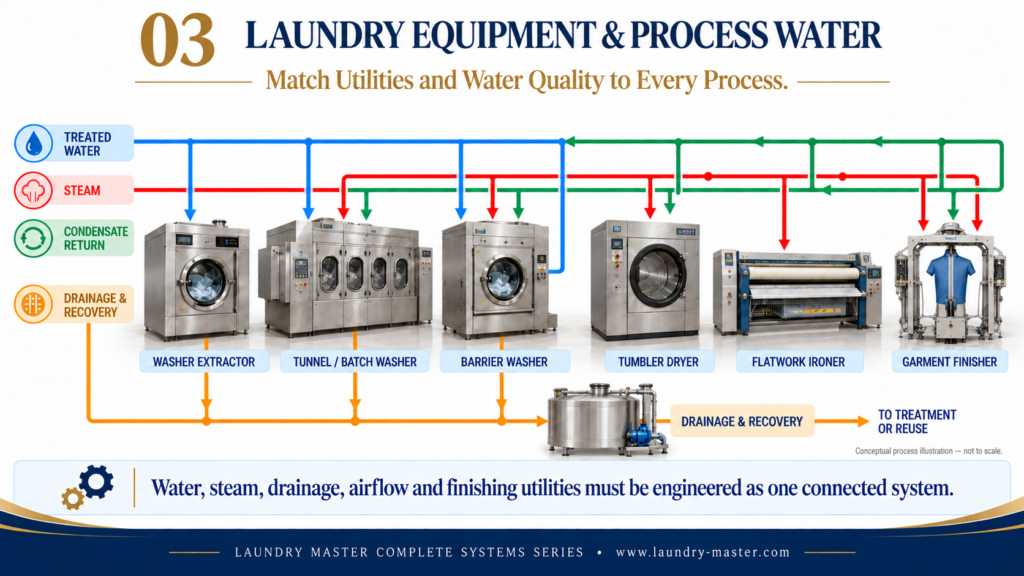
Match utilities to the actual process
Washer extractors, tunnel washers and barrier washers use water and drainage differently. Tumble dryers depend on heat input and airflow. Flatwork ironers and garment finishers depend on stable steam, condensate removal and ventilation. A utility schedule should therefore be based on each machine programme and simultaneous peak demand, not only on nominal connected capacity.
A programme stored in a controller is not proof of what the textile receives. Operators should verify fill time, water level, temperature rise, chemical injection, rotation, drainage and extraction. Steam pressure at the boiler does not prove correct pressure or quality at the machine. Drain capacity should be checked during coincident discharges, especially where segregated recovery streams are planned.
Utility interfaces to verify
| Equipment | Principal utility interfaces | Common verification |
|---|---|---|
| Washer extractor | Treated water, chemicals, drainage and extraction | Fill time, level, temperature, dosing, drain sequence and residual condition |
| Tunnel washer | Counterflow water, dosing, transfer and recovery | Compartment balance, flow direction, press extraction and water quality by zone |
| Barrier washer | Dirty-side loading and clean-side unloading | Area separation, door interlock, validated cycle and controlled airflow |
| Tumble dryer | Heat, airflow and exhaust | Inlet heat, exhaust restriction, dryness endpoint and lint control |
4 Boiler steam and condensate return
Steam quality depends on the complete loop
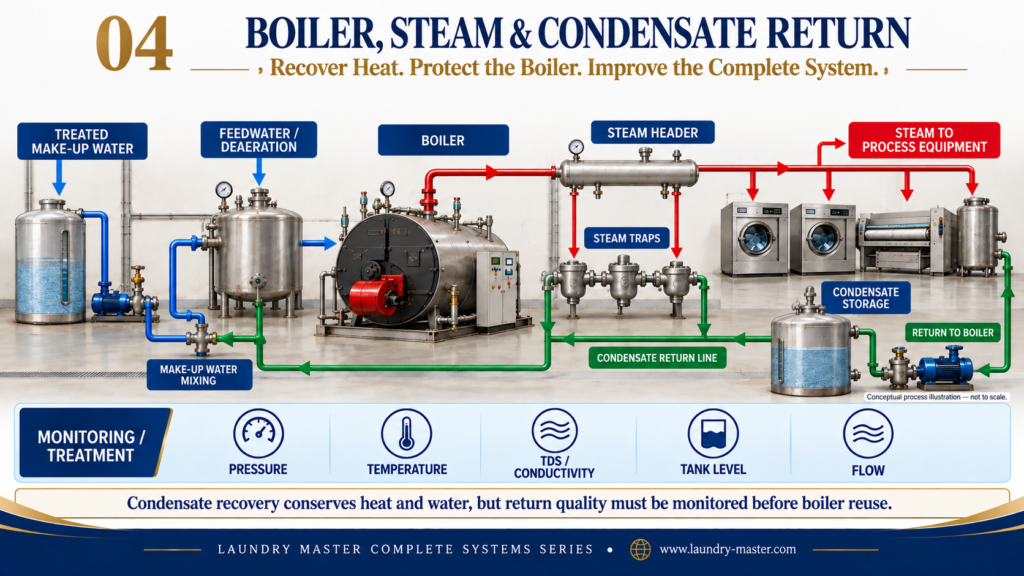
Boiler performance begins with suitable make-up water and controlled feedwater preparation. Distribution must deliver dry steam at the pressure and flow required by the equipment. Separators, drip legs, traps, strainers, pressure controls, insulation and condensate piping should be selected and maintained as one system. Accumulated condensate can restrict heat transfer, contribute to corrosion and create waterhammer risk.
The U.S. Department of Energy identifies condensate return as an important steam-system efficiency measure because returned condensate can reduce make-up water, water-treatment demand, sewer discharge and the fuel required to heat colder make-up water. The economic value depends on temperature, quantity, hours, fuel, water, treatment and discharge costs.
Return only suitable condensate
Condensate is generally valuable, but process contamination is a legitimate concern. Where contamination is possible, the return system should include appropriate monitoring and a safe diversion arrangement. Conductivity and pH are commonly used indicators; the required instruments and limits depend on the possible contaminant. A return decision should be defined before an abnormal result occurs. Laundry Master Volume 1 Issue 2
Control points
| Control point | What to confirm | Why it matters |
|---|---|---|
| Boiler feedwater | Treatment, temperature, dissolved oxygen control and chemical programme | Protect heat-transfer surfaces and support stable operation |
| Steam header | Pressure, drainage, insulation and correct take-offs | Deliver useful steam and limit carried-over condensate |
| Steam traps | Correct type, capacity, installation and operating condition | Remove condensate and air without losing live steam |
| Condensate receiver | Temperature, level, venting, pump control and contamination risk | Preserve heat and return water reliably |
| Return monitoring | Defined parameters, alarm limits and diversion action | Prevent unsuitable condensate from reaching the boiler house |
5 Multi drain water reuse and recycling
Separate before streams are mixed
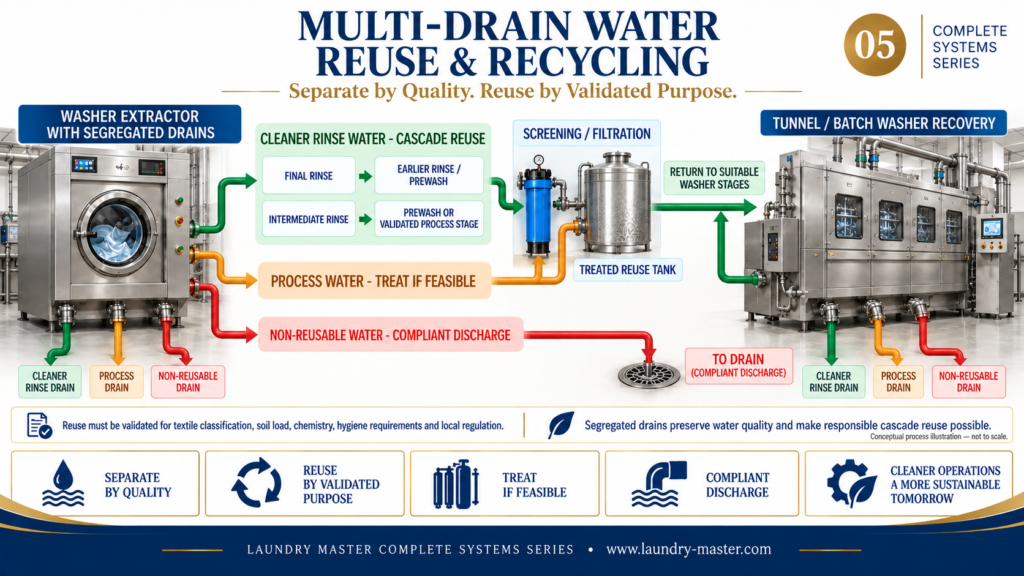
The most valuable step in reuse design may be drain segregation. Once relatively clean rinse water is mixed with heavily soiled wash liquor, the combined stream becomes more difficult and expensive to reuse. Multiple drain valves and dedicated lines can preserve streams with different quality, provided the machine sequence, valve integrity and destination are controlled.
Cascade reuse sends a cleaner later rinse to an earlier stage such as a first rinse or prewash. It can be simpler than full wastewater treatment because the water remains within a defined process sequence. However, suitability depends on textile classification, colour, soil, chemistry, dissolved solids, hygiene duty and the risk of accumulation over repeated cycles.
A reuse decision requires evidence
- Identify every candidate stream and its variability.
- Define the exact next use rather than describing the water as clean.
- Set acceptance parameters and sampling points for that use.
- Provide separate tanks or lines where mixing would destroy value.
- Prevent backflow and cross-connection with fresh or potable systems.
- Provide automatic or manual diversion when quality is outside the agreed range.
- Compare capital, maintenance and treatment cost with water and disposal savings.
- Revalidate after changes to textiles, chemistry, programmers or production mix.
Illustrative cascade logic
| Recovered stream | Possible next use | Conditions requiring validation |
|---|---|---|
| Final rinse | Earlier rinse or selected prewash | Residual chemistry, colour transfer, hygiene and final-quality objectives |
| Intermediate rinse | Prewash or another defined low-risk stage | Soil load, alkalinity, dissolved solids and textile compatibility |
| Selected process water | Treatment followed by defined reuse | Treatability, storage stability, operating cost and fail-safe control |
| Unsuitable mixed wastewater | Compliant treatment or discharge | Permit conditions, temperature, pH, solids, chemicals and local requirements |
6 Monitoring safety and optimisation
Measure parameters that lead to action
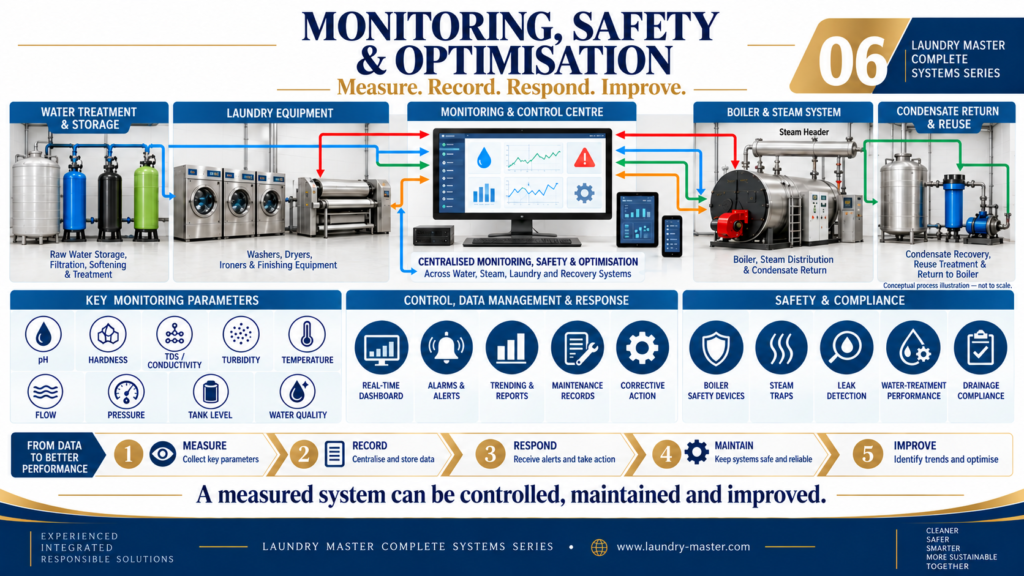
Instrumentation has value only when each measurement has a defined purpose, acceptable range, response and owner. More sensors do not automatically create control. The monitoring plan should identify the location, instrument, method, frequency, calibration requirement, record format and corrective action for each important parameter.
Trend information is often more useful than an isolated number. A gradual increase in hardness after a softener, conductivity in recovered water, fill time at the washer or condensate-return losses can reveal deterioration before the customer sees a quality problem. Automated alerts should be prioritised so that operators can distinguish a warning from a condition requiring shutdown or diversion.
Minimum data architecture
| Layer | Examples | Required discipline |
|---|---|---|
| Field measurement | Flow, pressure, temperature, level, pH, hardness, conductivity and turbidity | Correct location, suitable range, calibration and maintenance |
| Control | Valve position, pump command, tank level logic and diversion | Documented sequence, safe state and tested interlocks |
| Record | Batch data, trends, alarms, maintenance and laboratory results | Time stamp, traceability, retention and access control |
| Response | Operator action, maintenance request, escalation and shutdown | Named responsibility, response time and verification of recovery |
| Improvement | Baseline, normalised consumption and recurring loss analysis | Comparable production basis and controlled change |
Safety remains independent of optimisation
Energy or water savings must not bypass boiler safeguards, pressure protection, electrical isolation, chemical handling controls, confined-space procedures, infection-control requirements or environmental permits. Safety-critical devices should remain subject to competent inspection, testing and legal requirements even when operational data appears normal.
7 Monitoring safety and optimisation
Measure parameters that lead to action
Instrumentation has value only when each measurement has a defined purpose, acceptable range, response and owner. More sensors do not automatically create control. The monitoring plan should identify the location, instrument, method, frequency, calibration requirement, record format and corrective action for each important parameter.
Trend information is often more useful than an isolated number. A gradual increase in hardness after a softener, conductivity in recovered water, fill time at the washer or condensate-return losses can reveal deterioration before the customer sees a quality problem. Automated alerts should be prioritised so that operators can distinguish a warning from a condition requiring shutdown or diversion.
Minimum data architecture
| Layer | Examples | Required discipline |
|---|---|---|
| Field measurement | Flow, pressure, temperature, level, pH, hardness, conductivity and turbidity | Correct location, suitable range, calibration and maintenance |
| Control | Valve position, pump command, tank level logic and diversion | Documented sequence, safe state and tested interlocks |
| Record | Batch data, trends, alarms, maintenance and laboratory results | Time stamp, traceability, retention and access control |
| Response | Operator action, maintenance request, escalation and shutdown | Named responsibility, response time and verification of recovery |
| Improvement | Baseline, normalised consumption and recurring loss analysis | Comparable production basis and controlled change |
Safety remains independent of optimisation
Energy or water savings must not bypass boiler safeguards, pressure protection, electrical isolation, chemical handling controls, confined-space procedures, infection-control requirements or environmental permits. Safety-critical devices should remain subject to competent inspection, testing and legal requirements even when operational data appears normal.
8 Healthcare hygiene considerations
Healthcare laundry requires additional controls because soiled textiles may contain microorganisms and body substances. The U.S. Centers for Disease Control and Prevention advises minimum agitation when handling contaminated textiles, suitable containment, appropriate personal protective equipment and physical or airflow separation between contaminated receiving and clean processing areas. Equipment should be used and maintained according to manufacturer instructions.
Water reuse in healthcare laundry cannot be transferred directly from a general commercial application. The intended textile, patient risk, validated laundering process, local health requirements and possible cross-contamination routes must be reviewed. Clean-looking water is not evidence of microbiological suitability.
Hygiene design questions
- Are soiled and clean textile routes separated?
- Can aerosols, carts, staff movement or airflow recontaminate clean textiles?
- Is recovered water excluded from stages where the validated process requires fresh water?
- Are tanks and lines designed to avoid stagnation and permit cleaning?
- Are time, temperature, chemistry and mechanical action controlled and recorded where required?
- Are clean textiles dried, packaged, transported and stored to prevent recontamination?
This publication does not establish a healthcare validation protocol. Healthcare laundries must follow the requirements of the responsible health authority, customer, validated process, equipment and chemical suppliers, and applicable standards.
9 Operating checklists and implementation
Daily operating review
- Confirm raw, treated and reuse tank levels and abnormal overflow or leakage.
- Check treatment alarms, pressure loss and chemical or salt availability.
- Compare washer fill time, temperature and drainage with normal performance.
- Observe steam pressure, condensate return, unusual noise and visible leakage.
- Review reuse-system quality status and diversion condition.
- Record abnormalities and verify that corrective action is assigned.
Weekly or planned review
- Test defined water-quality points and compare trends.
- Inspect strainers, filters, tanks, vents, pumps and accessible valves.
- Review softener regeneration, hardness breakthrough and salt consumption.
- Check steam traps according to the site programme and investigate losses.
- Compare water, fuel or steam use with production on a consistent basis.
- Review alarms that were acknowledged without a completed corrective action.
Implementation sequence
- Map the current system and confirm actual flow paths.
- Measure baseline water, energy, steam, production and discharge.
- Define quality requirements at each point of use.
- Identify losses, bottlenecks and recoverable streams.
- Prioritise safety and low-cost control improvements.
- Pilot reuse or recovery changes on a controlled scope.
- Verify textile quality, hygiene, equipment and environmental performance.
- Standardise the approved change and continue trending.
10 Conclusion
Professional laundry engineering depends on controlling interfaces. Source water, treatment, storage, distribution, machines, steam, condensate, drainage and reuse cannot be managed as unrelated purchases. Each has an effect on the next part of the system and on the textile returned to the customer.
The practical method is consistent throughout this issue: define the requirement, measure the actual condition, select treatment or equipment for the identified duty, verify performance at the point of use, and record the response when conditions change. This approach supports better technical decisions without assuming that one design, treatment train or operating value fits every laundry.
Editorial and professional practice disclaimer
Laundry Master is an independent educational and professional knowledge initiative. The information in this publication is intended for education and professional reference. It does not replace equipment or chemical manufacturers instructions, textile care requirements, validated healthcare procedures, workplace safety requirements, environmental permits, applicable laws, codes, regulatory standards, site-specific risk assessments or independent professional advice.
Numerical values and examples must be interpreted in their stated context. Operating targets should be established for the actual site, source water, process, textiles, chemistry, equipment, hygiene objective and applicable regulation. Laundry Master, the publisher, editor, contributors and advisers accept no liability for loss, damage, injury or non-compliance arising from interpretation or application of this information.
Reference note
The references provide general technical context. They do not create universal laundry specifications. Users must verify current editions, local requirements and the suitability of each recommendation for their own operation.
Copyright
© 2026 Laundry-Master.com. All Rights Reserved.
No part of this publication may be reproduced, translated, stored, transmitted or distributed in any form without prior written permission from the publisher, except for brief quotations used with appropriate acknowledgement for educational, academic or professional review purposes.



Leave a Reply